
Peptide appearance
Lyophilized form
Solvent not included
Bacteriostatic water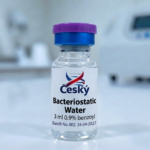
Bacteriostatic water 3 ml
+ 99 €
- Redox cofactor: Transfers electrons between the NAD+ and NADH forms in glycolysis, the citric acid cycle and the respiratory chain.
- Sirtuin substrate: The enzymes SIRT1 to SIRT7 consume NAD+ when removing acetyl groups from proteins.
- DNA repair: PARP enzymes consume NAD+ in response to DNA damage.
- Ageing research: The decline in tissue NAD+ concentrations with age is a repeatedly described observation.
Preparing a stock solution
The vial contains 500 mg. Dissolving it in 5.0 ml of solvent gives a stock solution with a concentration of 100 mg/ml, i.e. 100 µg in every microlitre. In the laboratory the solvent used is sterile or bacteriostatic water, or a buffer according to the method. Add the solvent slowly down the inside wall of the vial and let the contents dissolve with gentle swirling, not shaking – shaking can damage the coenzyme. The lyophilisate is hygroscopic – let a chilled vial come to room temperature before opening so that moisture does not condense on the powder. Divide the stock solution into aliquots and freeze them; repeated thawing reduces the content. The reconstitution calculator works out conversions for other volumes and dilutions using C1V1 = C2V2.
The reconstitution calculator works out exact conversions for other volumes, draws in microlitres and dilutions using C1V1 = C2V2.
- NAD+ is not a registered medicinal product in the EU or elsewhere.
- Most data on its effects on metabolism come from cell cultures and animal models.
- The lyophilisate is hygroscopic and degrades when exposed to air humidity.
- The solution is sensitive to repeated freezing and thawing.
NAD+ 500 mg
1 VIAL
Regular price
2 VIALS
10% off
3+ VIALS
15% off
 Z-Box / address
Latest test results
Test results for this product have not been added yet.
What NAD+ (nicotinamide adenine dinucleotide) is
NAD+, in full nicotinamide adenine dinucleotide, is a coenzyme present in all living cells. It is neither a peptide nor a protein – the molecule consists of two nucleotides joined by a bridge of two phosphate groups. One nucleotide carries nicotinamide (the amide of nicotinic acid, i.e. vitamin B3), the other adenine. The molecular formula is C₂₁H₂₇N₇O₁₄P₂ and the molecular weight is 663.43 g/mol.
The substance was described by Arthur Harden and William Young as early as 1906 during experiments with yeast extracts; its structure was elucidated in the 1930s by Hans von Euler-Chelpin. Today NAD+ is one of the best-studied cofactors in biochemistry and appears in practically every textbook on cell metabolism.
The NAD+ and NADH redox pair
The main role of NAD+ in the cell is electron transfer. The molecule exists in two forms that convert into each other: the oxidised form NAD+ accepts electrons and becomes the reduced form NADH, which can pass them on in turn. The reaction takes place on the nicotinamide ring; the rest of the molecule serves for recognition by the enzyme.
This redox pair links the main metabolic pathways. NAD+ is consumed in glycolysis and the citric acid cycle, while the resulting NADH passes electrons to the respiratory chain in the inner mitochondrial membrane. The NAD+/NADH ratio is therefore one of the indicators used in cell studies to assess a cell's energy state.
NAD+ as a substrate: sirtuins, PARP and CD38
Besides its role as an electron carrier, NAD+ has a second function: some enzymes consume it as a substrate, cleaving the molecule in the process. They include three groups that appear most often in the literature:
- Sirtuins (SIRT1 to SIRT7) – remove acetyl groups from proteins and consume one molecule of NAD+ in every reaction. Their activity is thus directly tied to its availability in the cell.
- PARP enzymes – involved in repairing damaged DNA. With extensive damage they consume NAD+ in large amounts.
- CD38 – an ectoenzyme that cleaves NAD+ and is described in the literature as one of the factors affecting its levels in tissues.
It is this second function that explains why NAD+ appears in research on cellular ageing: the coenzyme pool is finite and several enzyme systems compete for it.
The salvage pathway and the precursors NMN and NR
Cells do not mainly make NAD+ from scratch but recycle it through the so-called salvage pathway from nicotinamide, which is produced precisely in sirtuin and PARP reactions. The key, rate-limiting step is the enzyme NAMPT. A smaller part is made de novo from the amino acid tryptophan.
Precursors that are often used in research enter the same pathway:
- NMN (nicotinamide mononucleotide) – produced by NAMPT and the immediate precursor of NAD+.
- NR (nicotinamide riboside) – converted to NMN by the enzymes NRK1 and NRK2.
The difference between NAD+ and its precursors is therefore where they enter the pathway. NAD+ is the final molecule that enzymes actually use; NMN and NR are intermediates from which the cell still has to make it.
NAD+ in ageing research
A repeatedly published observation is that NAD+ concentrations decline with age in many tissues. The explanation under discussion combines lower NAMPT activity, higher consumption by PARP enzymes as DNA damage accumulates and rising CD38 activity. These observations come mainly from cell cultures and animal models; their transferability to humans remains a matter of debate, and good-quality clinical data are still scarce.
In longevity research, NAD+ is therefore studied together with other substances involved in cell metabolism.
Reconstitution and storage
Lyophilized NAD+ is hygroscopic, meaning it readily absorbs moisture from the air. Before opening a chilled vial, let it come to room temperature so that water does not condense on the powder. Add the solvent slowly down the side of the vial and let the contents dissolve with gentle swirling, not shaking.
A 500 mg vial gives a solution with a concentration of 100 mg/ml after adding 5 ml of solvent. Our reconstitution calculator works out exact conversions for other volumes, draws in microlitres and dilutions using C1V1 = C2V2.
Store the powder dry and dark, long term at −20 °C. Keep the solution at 2–8 °C; if you will not use it within weeks, divide it into aliquots and freeze them to avoid repeated thawing. The article how to store peptides summarises the details. For reconstitution we offer bacteriostatic water.
Specifications
Molecular profile
C21H27N7O14P2
Molecular weight
663.43 g/mol
CAS
53-84-9
Molecule type
Dinucleotide (coenzyme)
Form
Lyophilized powder, 500 mg
Peptides in transit
We ship lyophilized peptides in glass vials by standard shipping; they do not need refrigeration. Short temperature fluctuations in transit do not reduce their quality, and the lyophilized form stays stable for several weeks even in summer temperatures.
Storing lyophilized peptides
Store lyophilized peptides in a dry place, protected from light and moisture. We generally recommend these conditions:
- Room temperature (15–25 °C): up to 3 months
- In the fridge (2–8 °C): up to 6 months
- In the freezer (−20 °C and below): 3–5 years (recommended for long-term storage)
After taking the vial out of the fridge or freezer, let it warm to room temperature.
Storing reconstituted peptides
Peptide solutions are generally less stable after reconstitution than the lyophilized form, so keep them cold whenever possible. We generally recommend these conditions:
- Room temperature (15–25 °C): not recommended long term
- In the fridge (2–8 °C): usually 4–8 weeks
- In the freezer (−20 °C and below): up to 3–4 months
To keep the peptide intact, avoid repeated freezing and thawing, which can speed up its degradation.
Important:
Most manufacturers recommend using reconstituted peptides stored at 2–8 °C within 4 weeks. This recommendation is deliberately cautious and may not reflect the actual chemical stability of every peptide. In our own stability tests, many peptides dissolved in bacteriostatic water showed no measurable degradation after 12 weeks in the fridge. Stability depends strongly on the sequence and formulation, however, so this result cannot be generalised to all peptides without more data.
Scientific sources and citations will appear here.
Every new formulation is based on data from reliable scientific sources:




Be the first to review “NAD+ 500 mg”