
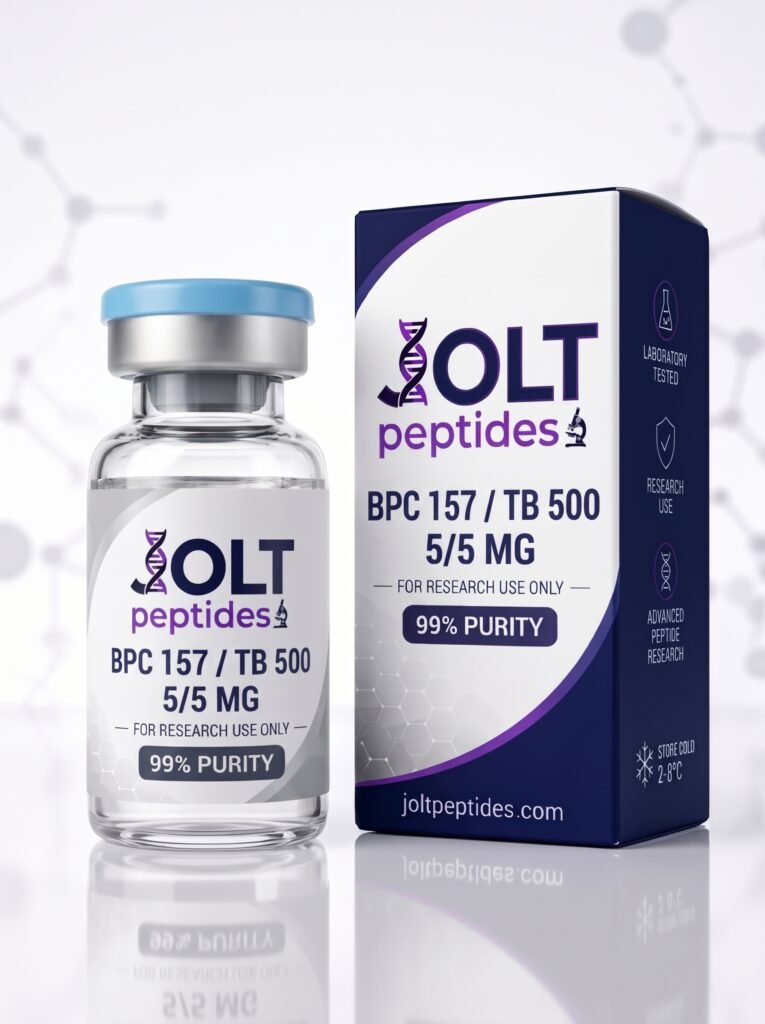
Peptide appearance
Lyophilized form
Solvent not included
Bacteriostatic water
Bacteriostatic water 3 ml
+ €4
- BPC-157: Tendon, ligament, muscle and gut healing models.
- TB-500: Thymosin β4 fragment – cell migration and repair.
- Angiogenesis: New blood vessel formation in animal models.
- Combined use: Two complementary repair mechanisms.
Preparing a stock solution
The vial contains 5 mg + 5 mg. Dissolving it in 2.0 ml of sterile or bacteriostatic water gives 2.5 mg/ml of each peptide. Add the solvent slowly down the inside wall of the vial and swirl gently, do not shake. Divide the stock solution into aliquots and freeze them. The reconstitution calculator works out other volumes and dilutions.
- Neither BPC-157 nor TB-500 is an approved medicinal product.
- Almost all data come from cell and animal models; human studies are very scarce.
- Data on the two peptides combined are limited.
- For laboratory research only.
BPC-157 + TB-500 5 mg + 5 mg
1 VIAL
Regular price
2 VIALS
10% off
3+ VIALS
15% off
 Z-Box / address
Latest test results
Test results for this product have not been added yet.
What this blend is
The vial contains two peptides studied in tissue repair research:
- BPC-157 – a synthetic pentadecapeptide (15 amino acids) derived from a protein found in gastric juice. It is studied mainly in animal models of tendon, ligament, muscle and gut healing and of blood vessel formation.
- TB-500 – a synthetic peptide based on the active region of thymosin β4, a protein involved in cell migration and actin binding. It is studied in models of wound and muscle repair.
The combination is used to study whether the two mechanisms complement each other. Neither substance is an approved medicinal product, and almost all data come from cell and animal models.
Reconstitution and storage
Dissolving the vial in 2.0 ml of solvent gives 2.5 mg/ml of each peptide. The reconstitution calculator works out other volumes; for reconstitution we offer bacteriostatic water.
Store the lyophilisate dry and dark, long term at −20 °C. Keep the solution at 2–8 °C, divide it into aliquots for longer storage and avoid repeated thawing. More in how to store and ship peptides.
For laboratory research only. Not for human consumption.
Specifications
BPC-157 sequence
Gly-Glu-Pro-Pro-Pro-Gly-Lys-Pro-Ala-Asp-Asp-Ala-Gly-Leu-Val
BPC-157
5 mg · CAS 137525-51-0
BPC-157 weight
1419.5 g/mol
TB-500
5 mg
Form
Lyophilized powder, 10 mg total
Peptides in transit
We ship lyophilized peptides in glass vials by standard shipping; they do not need refrigeration. Short temperature fluctuations in transit do not reduce their quality, and the lyophilized form stays stable for several weeks even in summer temperatures.
Storing lyophilized peptides
Store lyophilized peptides in a dry place, protected from light and moisture. We generally recommend these conditions:
- Room temperature (15–25 °C): up to 3 months
- In the fridge (2–8 °C): up to 6 months
- In the freezer (−20 °C and below): 3–5 years (recommended for long-term storage)
After taking the vial out of the fridge or freezer, let it warm to room temperature.
Storing reconstituted peptides
Peptide solutions are generally less stable after reconstitution than the lyophilized form, so keep them cold whenever possible. We generally recommend these conditions:
- Room temperature (15–25 °C): not recommended long term
- In the fridge (2–8 °C): usually 4–8 weeks
- In the freezer (−20 °C and below): up to 3–4 months
To keep the peptide intact, avoid repeated freezing and thawing, which can speed up its degradation.
Important:
Most manufacturers recommend using reconstituted peptides stored at 2–8 °C within 4 weeks. This recommendation is deliberately cautious and may not reflect the actual chemical stability of every peptide. In our own stability tests, many peptides dissolved in bacteriostatic water showed no measurable degradation after 12 weeks in the fridge. Stability depends strongly on the sequence and formulation, however, so this result cannot be generalised to all peptides without more data.
Scientific sources and citations will appear here.
Every new formulation is based on data from reliable scientific sources:





Be the first to review “BPC-157 + TB-500 5 mg + 5 mg”