
Peptide appearance
Lyophilized form
Solvent not included
Bacteriostatic water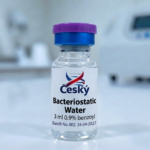
Bacteriostatic water 3 ml
+ 99 €
- Oxidative stress: The behaviour of cell cultures exposed to oxidative damage.
- Neuron viability: Models of nerve cells under oxygen or nutrient deprivation.
- Gene expression: Changes in the expression of selected genes in cell models.
- Short peptides: Belongs to the group of bioregulators of two to four amino acids.
Preparing a stock solution
The vial contains 10 mg. Dissolving it in 2.0 ml of solvent gives a stock solution with a concentration of 5 mg/ml, i.e. 5 µg in every microlitre. In the laboratory the solvent used is sterile or bacteriostatic water, or a buffer according to the method. Add the solvent slowly down the inside wall of the vial and let the contents dissolve with gentle swirling, not shaking – shaking can damage the peptide. Divide the stock solution into aliquots and freeze them; repeated thawing reduces the content. The reconstitution calculator works out conversions for other volumes and dilutions using C1V1 = C2V2.
The reconstitution calculator works out exact conversions for other volumes, draws in microlitres and dilutions using C1V1 = C2V2.
- Pinealon is not a registered medicinal product in the EU or elsewhere.
- Published data come mainly from a single research group; independent replications are scarce.
- These are almost exclusively cell and animal models; clinical data are practically non-existent.
- The hypothesis that short peptides directly influence gene expression has not been independently confirmed.
Pinealon 10 mg
1 VIAL
Regular price
2 VIALS
10% off
3+ VIALS
15% off
 Z-Box / address
Latest test results
Test results for this product have not been added yet.
What Pinealon (Glu-Asp-Arg) is
Pinealon is a synthetic tripeptide made of three amino acids: glutamic acid, aspartic acid and arginine. In one-letter code the sequence is written EDR, in three-letter code Glu-Asp-Arg. The molecular formula is C₁₅H₂₆N₆O₈, the molecular weight 418.41 g/mol and the CAS registry number 175175-23-2.
It is therefore a very short molecule – for comparison, Semax has seven amino acids. Short length is characteristic of the whole group Pinealon belongs to, and it is also why a different mechanism is discussed for it than for longer peptides.
Short peptide bioregulators and Khavinson's group
Pinealon came out of the short peptide bioregulator programme led since the 1970s by Vladimir Khavinson at the St. Petersburg Institute of Bioregulation and Gerontology. The programme originally started from animal tissue extracts, from which short peptides of two to four amino acids were later isolated and synthesised.
The working hypothesis of this group is that such short peptides can penetrate the cell nucleus and interact directly with DNA or histones, thereby influencing the expression of specific genes. This hypothesis is stated repeatedly in the literature, but independent verification outside the original group is scarce and the transferability of the results remains an open question. It is worth taking this limitation into account when planning an experiment.
What is studied with Pinealon
Published work with Pinealon focuses on several areas:
- Oxidative stress – the behaviour of cell cultures exposed to oxidative damage.
- Neuron viability – models of nerve cells under oxygen or nutrient deprivation.
- Gene expression – changes in the expression of selected genes in cell models.
- Tissue ageing models – cultures taken from older animals compared with younger ones.
The vast majority of these data come from cell cultures and animal models. Clinical studies in humans are practically non-existent, and Pinealon is not a registered medicinal product in the European Union or anywhere else.
Pinealon and Epitalon: how they differ
Both substances come from the same research programme, are often mentioned together and sit side by side in catalogues. However, they differ both in sequence and in their published focus:
| Property | Pinealon | Epitalon |
|---|---|---|
| Sequence | Glu-Asp-Arg (EDR) | Ala-Glu-Asp-Gly (AEDG) |
| Number of amino acids | 3 | 4 |
| Mol. weight | 418.41 g/mol | 390.35 g/mol |
| Published focus | Oxidative stress, neurons | A different body of work |
Pinealon is therefore not a shorter version of Epitalon – it is a different sequence with a different amino acid composition, even though both belong to the same group of short peptides.
Reconstitution and storage
Pinealon is supplied as a lyophilized powder in a glass vial. A 10 mg vial gives a solution with a concentration of 5 mg/ml after adding 2 ml of solvent, i.e. 5 µg in every microlitre. Our reconstitution calculator works out exact conversions for other volumes, draws in microlitres and dilutions using C1V1 = C2V2.
Add the solvent slowly down the inside wall of the vial and let the contents dissolve with gentle swirling, not shaking. For reconstitution we offer bacteriostatic water with 0.9% benzyl alcohol.
Store the lyophilisate dry and dark, long term at −20 °C. Keep the solution at 2–8 °C and use it within weeks; for longer storage, divide it into aliquots and freeze them so it is not thawed repeatedly. You will find a detailed overview of conditions in the article how to store and ship peptides.
Specifications
Molecular profile – sequence
Glu-Asp-Arg (EDR)
Molecular formula
C15H26N6O8
Molecular weight
418.41 g/mol
CAS
175175-23-2
Form
Lyophilized powder, 10 mg
Peptides in transit
We ship lyophilized peptides in glass vials by standard shipping; they do not need refrigeration. Short temperature fluctuations in transit do not reduce their quality, and the lyophilized form stays stable for several weeks even in summer temperatures.
Storing lyophilized peptides
Store lyophilized peptides in a dry place, protected from light and moisture. We generally recommend these conditions:
- Room temperature (15–25 °C): up to 3 months
- In the fridge (2–8 °C): up to 6 months
- In the freezer (−20 °C and below): 3–5 years (recommended for long-term storage)
After taking the vial out of the fridge or freezer, let it warm to room temperature.
Storing reconstituted peptides
Peptide solutions are generally less stable after reconstitution than the lyophilized form, so keep them cold whenever possible. We generally recommend these conditions:
- Room temperature (15–25 °C): not recommended long term
- In the fridge (2–8 °C): usually 4–8 weeks
- In the freezer (−20 °C and below): up to 3–4 months
To keep the peptide intact, avoid repeated freezing and thawing, which can speed up its degradation.
Important:
Most manufacturers recommend using reconstituted peptides stored at 2–8 °C within 4 weeks. This recommendation is deliberately cautious and may not reflect the actual chemical stability of every peptide. In our own stability tests, many peptides dissolved in bacteriostatic water showed no measurable degradation after 12 weeks in the fridge. Stability depends strongly on the sequence and formulation, however, so this result cannot be generalised to all peptides without more data.
Scientific sources and citations will appear here.
Every new formulation is based on data from reliable scientific sources:






Be the first to review “Pinealon 10 mg”